

Becoming a Crime Scene Investigator
What steps can you take to become a Crime Scene Investigator or Forensic Scientist? We have outlined the four steps you should take to get one of these fascinating careers: Learn, Prepare, Apply and Test.
Step #1: Learn about the job.
What does a Crime Scene Investigator do? What skills, knowledge and abilities are required? What education and experience is needed to qualify for the job?
The answers depend on the exact job you apply for and the agency that offers the job. Read the job summaries of the job openings listed on the Employment page. This will give you an idea of the variety of responsibilities the employee will have as well as the minimum requirements to apply for the job.
Also, read over the material on the Crime-Scene-Investigator.net (this website). There is a variety of information that will help you understand the job of a Crime Scene Investigator. Watch the video Traits of a Successful Crime Scene Investigator to see if you are a good candidate to be a Crime Scene Investigator. One article, Duty Description for the Crime Scene Investigator, by Mike Byrd of the Miami-Dade Police Department Crime Scene Investigations Unit, gives a good description of what a Crime Scene Investigator does on the job.
One of the best things you can do is to contact agencies in the geographical area you wish to work and find out what their Crime Scene Investigators do on the job, what their minimum requirements for applying are, and how often they have job openings.
Are there Crime Scene Technician jobs available?
According to the U.S. Department of Labor, Bureau of Labor Statistics, a "forensic science technician" is a person employed to "collect, identify, classify, and analyze physical evidence related to criminal investigations" (this would include crime scene technicians who work in the field and technicians who work in the crime laboratory). The Bureau's Occupational Outlook Handbook, states: "Employment of forensic science technicians is projected to grow 13 percent from 2022 to 2032, much faster than the average for all occupations." Employment growth in State and local government is driven by the increasing application of forensic science techniques, such as DNA analysis, to examine, solve, and prevent crime. The report points out: "About 2,600 openings for forensic science technicians are projected each year, on average, over the decade. Many of those openings are expected to result from the need to replace workers who transfer to different occupations or exit the labor force, such as to retire."
In May 2023 the Bureau of Labor Statistics reported the mean hourly wage was $34.40 and the mean annual wage was $71,540 (annual wages at the 10 percentile were $41,410 and the 90 percentile were $107,490) for forensic science technicians. (Read the Bureau of Labor Statistics report) 
You can check a 2023 salary survey for CSI and forensic science jobs for many agencies in California, as well as agencies in Nevada, Arizona, Oregon, Washington, and Idaho: 2023 Salary Survey.
Some recent job openings posted on this website have the following pay scales listed:
- Crime Scene Investigator: $44,829 — $66,358 per year
- Property/Evidence Technician: $59,244 — $72,000 per year
- Supervising Forensic Investigator (CSI): $70,797 — $100,034 per year
- Forensic Specialist (Crime Scene): $52,459 — $86,669 per year
- Latent Print Technician: $64,813 — $75,504 per year
- Forensic Scientist Trainee: $46,815 — $78,319 per year
- Forensic Science Section Supervisor: $69,950 — $104,416 per year
- Criminalist: $64,937 — $110,873 per year
This website posts job openings. There are usually about 100 openings posted at all times. These listings include Crime Scene Investigation and Forensic Science jobs. You can read through the job openings on the employment page to see what types of jobs are available, and what the requirements are for the different positions.
Step #2: Prepare for the job.
Some positions require you have a 4 year degree in science while others only require a GED or High School graduation. Generally, if you want to work in a crime laboratory as a Criminalist you will need at least a 4 year degree in science (such as Biology, Chemistry or Forensic Science). If you want to be a Crime Scene Technician you usually need less formal education. Some agencies require you be a sworn police officer before becoming a Crime Scene Investigator—most do not.
If the position you want requires formal training then check your local colleges and universities. Many community colleges have Criminal Justice classes that include crime scene investigations.
Search for other campus based college or university program here: Campus Based CSI and Forensic Programs
Can I get training online to become a Crime Scene Technician?

You can also make yourself more marketable by earning a certificate or a degree in Crime Scene Investigations or Forensic Science online from a college with a respected program. Many online programs can be completed in less time than traditional campus based programs. Examples of respected online programs include (click on the links to receive free, no obligation, information):
 Crime Scene Technology
 Crime Scene Investigation Forensic Investigation Forensic Science - Bachelor's
 Forensic Science - Master's Biology: Forensic Science - Master's
The availability of each program is dependant on your zip code. Not all programs are available in every location.
Other related areas of study include (click on the topic to see lists of online colleges and universities offering these programs):
- Computer Forensics and Cyber Crime
- Forensic Psychology
- Forensic Accounting
- Criminal Justice
- Homeland Security
- Law Enforcement and Corrections
Complete listings of Colleges and Universities offering programs in CSI and Forensics:
- ONLINE Colleges and Universities offering CSI and Forensic programs
- CAMPUS BASED Colleges and Universities offering CSI and Forensic programs
Regardless of what the education and experience are for the job you are seeking, there are some things you can do to prepare for the job and the interview. Again, reading over the material on this website will give you some information. But if you really want to be prepared, you must do more. As a person who interviews candidates for law enforcement jobs I can tell you that agencies are inclined to give jobs to those who have a clear understanding of the job they are applying for, and have done something to prepare themselves for the job.
Watch the instructional videos on this website to have an understanding of crime scene techniques. During an interview you can expect to be asked questions about techniques to see if you really understand the duties of a Crime Scene Investigator. There are 70 instructional videos on this website with topics that include Crime Scene Investigation and Documentation, Evidence Collection, Latent Fingerprints, Footwear, Tire Track and Other Impressions, Firearms and Tool Mark Evidence, and Crime Scene and Evidence Photography. Mastering these subjects is vital to successful crime scene investigations. Understanding these subjects is vital for landing a job in crime scene investigations.
Another way to gain knowledge and be able to show you have prepared yourself is to read the right books. We strongly recommend you read the following book before interviewing for the job (and be sure you tell those interviewing you that you have read this book).
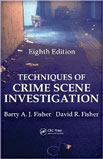 Techniques of Crime Scene Investigation by Barry A.J. Fisher (July 5, 2022)
This Ninth Edition examines concepts, field-tested techniques and procedures, and technical information concerning crime scene investigation. This comprehensive text has been widely adopted by police academies, community colleges, and universities. Three professional organizations (the International Association for Identification, the American Board of Criminalistics, and the Forensic Science Society) recommend this book as a text to prepare for their certification examinations. Find this book and other CSI and Forensic books here.
Step #3: Apply for the job.
Have a good resume. Even if the agency does not require a resume, attach one to the application. It can make the difference in getting an interview and even the job.
Check for job openings on the employment page. To be notified of job openings as they are posted, follow us on Twitter or sign up for daily email notifications. To sign up for the Crime Scene Investigator Newsletter and receive monthly notifications, go to the subscribe to the newsletter page.
It is often difficult to find a entry-level CSI job. The article Finding an entry level CSI job has suggestions for finding your first job as a Crime Scene Investigator.
Step #4: Testing and interview.
Many agencies will require you to pass a written examination followed by an interview. Find out what testing may be required by the agency with which you are applying. Some agencies have resources available, including study guides, you can review before the examination. An example is the Crime Scene Analyst Study Guide Booklet provided by the Las Vegas Metropolitan Police Department for their entry level Crime Scene Analyst position.
Be sure you do your homework before you have your interview. Learn about the agency and the community it serves. A favorite question asked in interviews is "What do you know about our department and what do you know about our community?" Be prepared to answer the typical questions.
Two articles on this website give tips on preparing for an interview:
- The Interview, by Steve Staggs
- Interviewing Tips, by Thomas W. Adair
Good Luck!
Crime scene investigations is an interesting and worthwhile career. We wish you the best in your endeavors.