

Photographic Techniques for the Laser or Alternate Light Source
Hayden B. Baldwin
Master Sergeant
Illinois State Police
Bureau of Crime Scene Services
As crime scene technicians we are accustom to photographing the crime scenes and using forensic photography techniques to capture on film the fingerprints, footwear patterns, toolmarks, bite marks and blood spatter patterns that are found at the various crime scenes. Why then do we have a problem photographing items with the laser or ALS source? We think of the laser or ALS as another light source, such as the photo bulb or electronic flash, however it is not the same photographic technique.
See also the instructional video "Evidence Photography — Alternate Light Sources"
When using the laser or ALS to photograph the processed prints we are now photographing the luminescence or florescence of the chemical used, not the light generated by the laser or ALS. We need to learn other photographic techniques to capture these images on film. There are certain rules that must be followed in order to capture these images.
- Know the limitations of the camera and film.
- Maintain a constant distance of the light source to the object for consecutive exposures.
- Locate a starting point by a camera meter reading or separate light meter.
- Bracket by at least 2 stops.
Using these simple rules you will capture quality images suitable for comparisons. Guaranteed!
An example of this would be the following:
Once the item has been processed, and you have selected the correct band cut off filter (red, orange, or yellow), set your camera on a sturdy tripod and at the proper distance take a meter reading. Your light source MUST be maintained at the same distance from the object for all consecutive exposures. Once you have the meter reading, set the camera manually to match that reading, take a picture at that exposure, then by changing either the aperture setting (f stop) OR the shutter speed by two settings take another exposure. Continued this procedure until you have bracketed your original setting by 2 stops.
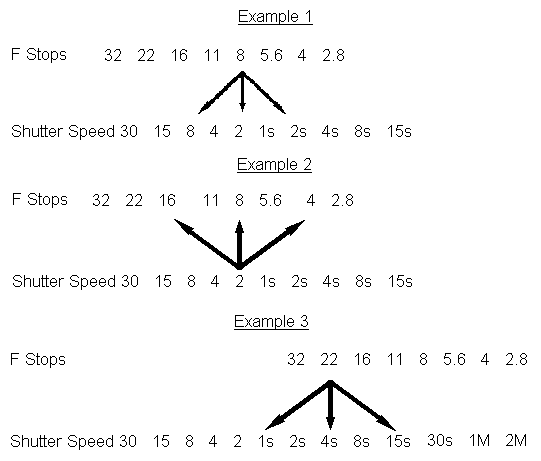
For instance, if the original meter reading was F8 at 1/2 second (see example one) then the least bracketing would be F8 at 2 seconds and F8 at 1/8 second. OR you can change the aperture (F stop) instead of the shutter speed by the following example. Using the original settings of F8 at 1/2 second (see example two) then bracket by F16 at 1/2 second and F4 at 1/2 second. NEVER MOVE BOTH THE APERTURE AND SHUTTER SPEED SETTINGS.
In the above two examples the picture quality would be the same. The exception to this rule would be the depth of field (amount of item in focus).
If the print you are trying to capture is on a flat surface then depth of field will have little or no bearing, however if the item is curved or the surface is irregular then use a smaller aperture opening (F16 or F22) to gain maximum depth of field. Using the above example again, if the object you are trying to photograph is curved (pop can, door knob, etc) then instead of using F8 at 1/2 second we would start at F22 at 4 seconds (see example three) and bracket at F22 at 15 seconds and F22 at 1 second.
There is a direct correlation between shutter speed and aperture openings, you need to understand this correlation and use it to capture quality photographs.
If the camera that you are using is not capable of automatic long exposures then the camera must be placed on the bulb setting and timed exposures can be taken by the use of a shutter release and a watch.
The capability of the black and white film is a 5 stop latitude. That means if your exposures are off a little it can still be corrected in the printing. The cure for this is simple, if you are not sure bracket, bracket, bracket!
One final note - PRACTICE, PRACTICE, PRACTICE, PRACTICE !!!
Article submitted by the author